Wednesday, 1 February 2017

Life on 'The Enchanted Isles'


I would have run straight past it had it not been for the loud, breathy hiss that made me stop in my tracks. It sounded threatening, but there was no sign of the fearsome reptile I would have expected to make such a noise. Instead, it came from what I had mistaken for a large boulder - the mottled brown outline of a Giant Tortoise, its head and legs hidden from sight inside its shell.

I could hardly believe my luck stumbling across one of the animal kingdom's great treasures on a morning run. Yet as I continued, I passed several more dome-shaped boulders that hissed as I passed. It did, however, take some time before I saw one with a head and legs outside of its shell. You see, despite the Darth Vader-esque vocals, imposing body armour and leathery scales worthy of a dinosaur, these gentle giants are shy, bashful creatures - they shrink into their shell with a hiss the moment you venture too close. It goes without saying that they are a huge upgrade from the feral dogs that stalked my running route on the mainland!

It turns out that my current home in the highlands on Galapagos's Santa Cruz is just a few roads up from the Giant Tortoise Reserve and, as its residents roam freely in the surrounding fields, I have got used to seeing these endearing beasts going about their business day to day. In fact, they are often pottering around by the stables every morning - frighteningly unaware of the damage that could be inflicted by the back legs of a disgruntled horse.


Avid grazers with a big appetite, they seem to go wherever the pasture is good. Slowly but steadily, they will chomp through their chosen patch of greenery, their long, crinkled necks stretching a surprising distance to select the juiciest morsels. Then, they'll lumber to their feet, take a few laboured but purposeful steps to their next location, and flumpf to the floor once more. It looks like hard work - and, if you're over 90 years old and heaving around a heavy shell, I expect it is!

The giants in the highlands are just the start of the wealth of wildlife living here. Thirteen miles away in Puerto Ayora, the island's main coastal town, you can't walk more than a few paces without seeing something photo-worthy. Marine iguanas (that, to me, seem wildly incongruous with the ocean vista) sit poised and proud on the pier, impervious to the paparazzi of tourists anxiously snapping their photo. Sea lions lounge on the decks by the boats, comfortable and carefree, their whiskers twitching as they snooze. Bright, red-yellow crabs - Sally Lightfoots - scuttle up vertical walls; hoards of Pelicans boldly harass the fishmongers as they gut that day's catch; and elegant, red-breasted Frigates soar across the sky. Put simply, it's hard to know where to look!


Of course, it's not all beaches, ocean vistas and incredible wildlife. Currently, I am helping to care for and train five young horses in return for free accommodation on site. The place I'm staying may be within striking distance of the Tortoise Reserve, but it's also just up the road from a pig farm. The screams of the animals going to slaughter (a daily occurrence) are enough to make the most fervent sausage-lover swear off meat for life. Similarly, the house is home to a veritable hive of insects. Cockroaches are just the start... I can't even name some of the monsters that appear after dark! In addition, there is a strong population of geckos. They make their presence known by poo-ing on every available surface at an incredible rate, but seem to do a very poor job of keeping the house insect-free.

On another note, last year's drought has made fruit, veg and water prized commodities on the island - never has being a vegetarian been so expensive! It also means running water at the house is limited and somewhat temperamental. Lowering buckets into the water tank as if it were a well and stockpiling it in basins for a cold shower has become a laborious chore. But, given that when the shower does work, it's a pathetic dribble from a hose that hangs at knee height, it's a job well worth doing.

Even so, all this seems like a fair exchange for living on 'The Enchanted Isles' - cockroaches and gecko poo included. I've been captivated by this carefully conserved haven from the word go. For the first time, the horses have taken a back seat in favour of everything else there is to see!


Wednesday, 25 January 2017

Training trials in Ecuador

My first run in Pesillo, a small farming village in the Northern Highlands of Ecuador, lasted just six minutes before the steady incline and high altitude had left me gasping for breath and my legs burning. It took several weeks of perseverance before I could just about complete a 5-mile loop of the valley without stopping. More on that here. When I moved on to a 4,500 dairy farm, I had high hopes my new lodgings would provide the perfect base for off-road running. Sadly, sludge so deep it slopped over the rim of my welly boots soon put pay to that idea. I was forced to take to the tarmac.

Vía Selva Alegre is a far cry from the cobbled tracks and family smallholdings of Pesillo. A wide, winding thoroughfare, it is lined with monstrous haciendas, each stretching several kilometres in length. The main traffic - a handful of vehicles every half hour - consists of enormous heavy goods trucks that to and fro between the farms, and local buses that follow a timetable consistent only in its unpredictability. The road slaloms through the hills at a steady but punishing gradient, wending its way gradually upwards for 3-4km before it eventually plateaus. Here, at the highest point, the haciendas are dispersed with a collection of very basic houses, each with a small backyard and a handful of animals. These lots are tiny in comparison to the farms here, but they undoubtedly enjoy some of the best views one could ask for.

On almost all of my runs along Vía Selva Alegre, I was accompanied by two of the farm's dogs - a fiercely loyal German Shepherd called Marca and her young protege, a black puppy called Valiente. An endearing pair, both would trot as close to my heels as physically possible. Sandwiched tightly between them, it's a miracle we didn't all trip and tumble when accelerating down the hill.

In fact, I soon learnt it was much safer running with my doggy escort than than venturing out without them - it turns out the canine residents of the local houses take their guarding duties very seriously. One Sunday, as I reached the highest point of my run, a black Pitbull charged into the road and sunk his fangs into my knee, leaving a nasty gash. Needless to say, I haven't gone back since. In fact, I now have the perfect excuse not to reach the top of the hill! Sadly, I'm also now terrified of any dog that happens to bark as I pass, and have even started to carry defensive ammunition with me (storing pebbles in my leggings and carrying a stick) if I know I'll have to pass a canine guard.

Running here in Ecuador certainly has its ups and downs, but I do have an incentive to keep at it. In October, I got a ballot place in the London Marathon. It's not ideal timing - I'll be travelling for the duration of the training period. Yet, having entered several years running and never yet been successful, it seems too good an opportunity to miss. With an uncertain few weeks ahead, I've no idea if I'll make it to the start line in April. But if I do, I just hope the trials and tribulations of my sporadic training in Ecuador will be enough to see me through the 26 miles to the finish!


Monday, 16 January 2017

A Masterclass in Ecuadorean Equitation


I've worked at livery stables, dealers yards, polo clubs and trail ride ranches, but it's fair to say I've never experienced anything quite like Hacienda Pambasinchi. So far, it's been a crash course in dealing with horses en masse. We have 80 here, divided into two herds and rotated around different pastures across an expansive 4,500 hectares. I've quickly learnt just how fast 80 horses can mow a field of long, lush grass to its yellowy roots - it makes for a lot of work shifting fence lines across vast swathes of farmland to ensure they have fresh grazing.

Despite the abundance of pasture, most days all the horses are rounded up to be fed and watered. Heaving 40kg bags of alfalfa through knee-deep sludge, spreading it across the five feeding troughs and topping each with a bucket of thick, sticky molasses decanted from an enormous metal vat, is a trial that has to be repeated at least three times to ensure no one is left hungry - the whole procedurecan take the best part of a day.

Any time left is spent working the 20 resident stallions. And Vinicio, the twenty-four-year-old Quechuan in charge here, has a unique technique to ensure no one is left out. First, he herds them all to the bubble-shaped ménage next to the coral where, in order to get in, all the horses have to jump a line of barrels about three foot high. The arena features a steep, in-built hill to one side, and the work begins by cantering all 20 horses together in circles up and over this hill at least ten times on each rein. However effective it is as a warm up, when they thunder past you at close range - a chaotic jumble of legs, tails and splattered mud - it can be quite unnerving! Subsequently, in groups of two or three, the horses are sent five or six times over a jump, before being allowed back into the main coral where their friends are waiting.

It's certainly not a style of training I'm familiar with, but it seems to yield results - as became evident when I rode the next day.  My horse, Myway, was superficially very scraggly. About 16'1hh, he had a fluffy coat marked with various scratches from the rough and tumble of the herd, and an endearing face covered in brown stickiness from the feed troughs. Following Vinicio's instructions, I didn't groom him or pick out his feet, just chose one of the three creaking English saddles from the store room and tacked him up - one size fits all apparently.

I wasn't expecting much as we squelched down the muddy track to the ménage. But, after just five minutes of riding, I knew that this scruffy four-year-old was a seriously classy horse in disguise. He glided around the arena with floaty, elevated paces, bending easily around the tight turns and sharp changes of rein that the small, bubble-shaped space made necessary. Just as round, collected and powerful in canter as he was in walk and trot, there's no doubt he'd easily cruise through affiliated dressage. In fact, his evident quality made wonder why on earth they had a rookie like me schooling him... but rather than question it, I just enjoyed the ride!

My next horse, a three-year-old stallion, was less successful. A striking charcoal grey called Martillo, he hadn't quite mastered the notion of going forwards. After a few hapless attempts to complete a full circle of the arena in trot, I was exhausted. It was a sharp bump back to reality when compared with the Ferrari I had been sitting on before.

Yet despite this particular stallion's confusion under saddle, it's obvious that the horses here are beautifully bred and produced - which says something about Vinicio's 'en-masse' training method. And I expect that, within a year, Martillo will be just as elegant Myway. Whether or not I have anything to do with that remains to be seen...


Wednesday, 11 January 2017

The Ecuadorean Dairy Farm

Just this week, I began a new job at a hacienda near Otavalo, a merchant town home to one of Ecuador's oldest markets. Compared with the small farming community I experienced in Pesillo, where each family has just a handful of animals, this is a dairy farm on an industrial scale.

The milking pens are the first thing you see on entering the hacienda. Twice daily the cows dutifully file into the courtyard and spread themselves out along the feed sheds, presenting a long line of bottoms as they feast on fresh alfafa. Then, they are shuffled into the milking parlour, where men in yellow, plastic overalls supervise machines that drain their udders in a matter of moments. It's a slick, professional routine that ticks over with clockwork regularity and never seems to change pace.

My bedroom is right next door to the pens, meaning I am very much up to speed with the milking timetable. Every morning at 3am, as I toss and turn in my wobbly, creaky bunk bed , the cows are harangued into the courtyard with cries of "siga siga vaca", and "vamos carajo" - noisy encouragement that I'm not convinced is entirely necessary given that, every time I've watched, the cows have walked obediently from pasture to pen without batting an eyelid.


The whole affair is repeated at 3pm. If I time it right, I can rush down and give one of the workers a plastic jug that, within seconds, will be full to the brim with warm, frothy milk - enough to last until the next afternoon's milking session. Already, that jug of milk has become a dietary staple for me. You see, the kitchen consists of a bench, a cupboard, and a two-ring electric stove. There's no fridge or running water, and dishes have to be washed in the tiny basin in the bathroom. It makes cooking anything more complicated than porridge quite a chore!

There are over 500 cows here, so there's no shortage of milk. And, as the hacienda boasts over 4,000 hectares of land, there's certainly ample grass for them to eat. In fact, the grounds are so vast they allow for multiple crops of sweetcorn and oats, as well as plentiful grazing for 65 horses.

Sadly, I've yet to work much with the horses here. My arrival was unfortunately timed and has coincided with torrential and persistent rain - the likes of which makes a wet day in Snowdonia look pedestrian. And, given the mud is already dangerously close to the top of my welly boots, I think it'll be a while before it dries out enough to start. However, in a window of fair weather today, I did manage to squeeze in a short ride on one of the stallions, a four year old that proved to be much better behaved than most of the cavalry blacks I am lucky enough to ride back home. With another 20 stallions, 45 mares and numerous foals just waiting to be played with, I'm praying the weather clears up soon!


Sunday, 8 January 2017

El Sargento


Cesar makes an entrance every time he arrives at la finca. Pausing in his stride a moment, he raises both his arms high above his head, looks around and grins broadly as if basking in the applause of an expectant crowd. "Estoy aquí," (I'm here). He's been working at la finca most days this week, and regularity certainly hasn't diminished his style. If anything, his appearance each day has become every day more grandiose.

Cesar is one of the chagras (Ecuadorean horsemen) who regularly joins the team at la finca to help prepare for the six-day trail rides - a monumental task that involves packing enough food, equipment and first aid to see 12 horses and ten riders through six days of adventure and all four seasons. I had been nervous about working with him - warned he would cut corners and slack off - but I needn't have worried. The first thing he said to me was "Yo trabajo, tu descanses," (I work so you can rest), and he has remained true to his word.

Small and round-faced, with a broad smile and a cheeky twinkle in his eye, Cesar is hard-working, efficient and cheerful. No matter how much work there is to get through, he remains implacably calm and relaxed. "Tranquila señorita", has become his catchphrase, repeated every time I try to plan ahead. It turns out he has been working these trail rides for over eight years, and so is well-versed in the extraordinary amount of paraphernalia involved. He certainly looks the part. At home, he wears jeans and a gillet, but when riding, he dons full-length, fur-fronted leather chaps, a thick, red and white woollen poncho and a broad-rimmed hat.

Yet this is just one of his jobs. At home, he has ten horses of his own that he uses to take Ecuadorean tourists on trail rides. He also milks his own cows every day and looks after the bulls at the local hacienda. Unbelievably, this is meant to be his retirement. Prior to all this, he spent 18 years in the Ecuadorean army - perhaps that explains why he can work such long hours and still be smiling. He also credits the army with his domestic skills. He always insists on doing the washing up and, if given half a chance, will light the fire in my bedroom to make sure I'm "calentita" (warm). Is it any wonder that after a day working with him I began to salute him as "El Sargento"?

*   *   *

Cesar is just one of the lovely local Ecuadoreans I have been lucky enough to meet. There's also Clemencia, who lives at the top of la finca and is full of smiles whenever we pass. For a dollar, she'll milk her cow and hand you over a bucket of fresh milk - something I'm yet to acquire a taste for. When she heard my housemate was ill, her whole family appeared on our doorstep armed with a little bottle of decongestant drops. I'm not sure that sort of neighbourly concern survives in London!


And then there's Kevin, the 17-year-old lorry driver. He manoeuvres the truck with the calm confidence of an old hand, and simply chuckled when he told me he's too young to have a driving licence. And there's Viktor, the happy-go-lucky chofer who gave up his lunch break to help me shift weighty water pipes and then drove me to town for groceries.

The charm, wit, concern and kindness of locals like Clemencia, Kevin and Victor - not to mention El Sargento - has been a highlight of my few weeks in Pesillo, Ecuador. Soon to be moving on, I only hope to meet similarly good-natured locals at my next stop.


Tuesday, 3 January 2017

Living in the Clouds

For the past few weeks, I've been living in the hills above Pesillo. It's a tiny farming community in the Northern Highlands of Ecuador, up at 3,000m and an hour and a half from the nearest town. Charged with looking after the herd of 14 horses and the resident border collie, there's been little time to explore any further than I can ride on horseback. Fortunately, I haven't felt much need to. The valleys are vast. You can ride for hours and still cover new ground. And their expansive beauty is breathtaking, no matter how many times you see it and no matter what the weather does.
.
Some days it's like living in a cloud - the air wet with tiny droplets of rain that shroud the valley in a misty haze. Waves of this feathery-light wisp will swirl through the hills all day, interspersed with fleeting glimpses of blue sky and bright sunshine - the translucent colours of rainbows arching over the valley are a regular sight. In the wetness of the clouds, it's easy to forget the hills are overlooked by the monstrous Volcán Cayambe. When it does appear, a brilliant ice white crag looming in the distance, it looks starkly out of place against the lush, rolling farmlands.
Though riding is undoubtedly the best way to enjoy the scenery, with most of the herd resting after a six-day tour, I've had no choice but to don my trainers and explore it on foot. Turning right out of la finca you can do a 5.5 mile loop of the valley. It's an undulating circuit that climbs over 700ft on a mixture of ankle-twisting cobbles and slippery, muddy tracks - and includes a constant assault by ferocious-sounding dogs that chase you past their property. It was an ambitious start for my first run at altitude and, needless to say, it took several attempts before I completed it without stopping. The locals undoubtedly think I'm completely bonkers - a red-faced "gringita" needlessly puffing her way up the cobbles in a laboured jog that's slower than walking pace. But, by and large, they seem to accept me. I get the odd smile and wave, or friendly honk from a passing truck.

On my most recent venture, la finca's elderly collie, Guapa, decided to join me. Ignoring my repeated instructions of "Quédate aquí " (Stay here), she snuck out of the gates after me, keeping a discrete distance behind. I didn't realise she was in tow until the battle cries of the first batch of guard dogs crescendoed to unprecedented levels. Terrified she'd be mauled by the neighbours or get lost, I spent most of the run glancing nervously over my shoulder and calling her on. But I needn't have worried. Despite remaining largely out of sight - about 70m behind me on a bendy track - she faithfully followed me the whole way. I stopped to wait for her on the home straight as she bowled towards me, ears flapping and tongue lolling as if smiling broadly. It's fair to say she finished much more strongly than I did.

Clearly, four legs are better than two. I should stick to the horses!


Tuesday, 20 December 2016

Early days at La Finca


The ranch looks a bit like a gingerbread house; a quaint, yellow stone cottage with timber rafters and a small porch - and 14 horses grazing in the garden. It's nestled deep in valleys of the northern highlands and overlooked by the awesome snow-capped peak of Cayambe volcano.

It's picturesque, but spartan. There's no heating, tap water must be boiled before drinking, milk (which comes from the cow next door) simmered before use, and clothes scrubbed clean(ish) in a bucket outside. The closest bus stop is a 30 minute walk along a muddy road lined with tethered pigs, hobbled cows, flocks of sheep and an assortment of dogs that chase you as you pass.

The sun is unforgiving in its strength, but rain is frequent and often torrential. Swirls of moody clouds spill through the valley each day - timing is key if you don't want to get wet. Up at over 3,000 metres, the nights are bitterly cold, and even a short walk in wellies leaves me out of breath.
Staying warm, fed and watered - and keeping the horses fit, healthy and happy - is quite a task. I've only been here a week and I'm already in a perpetual state of grubbiness. Local Ecuadorians however seem to manage life in the heart of the hills with much more grace.

Lots of the ladies wear traditional dress, and stroll along the muddied grassways looking effortlessly immaculate. They pair a vibrant, high-waisted skirt with a bright white blouse that has elaborately embroidered sleeves and coloured panels to match the skirt. Their neckline is hidden by a ruff of golden beads looped multiple times from collarbone to earlobe, and they top the outfit off with a smart, rimmed hat adorned with a ribbon and feather. Some of them have sleek, long hair and smooth, rosy cheeks; others, crinkled brown skin, a stooped back and few teeth. But all are equally elegant.

Of course, not everyone wears their Sunday best every day, but there is something quite special about seeing ladies go about day-to-day chores on the farm in traditional dress. I can only marvel at their ability to be so pristine! Clearly, there's a lot to learn from the locals about living in remote Ecuadorian countryside.


Tuesday, 23 December 2014

It's a grizzly business being a sheep...

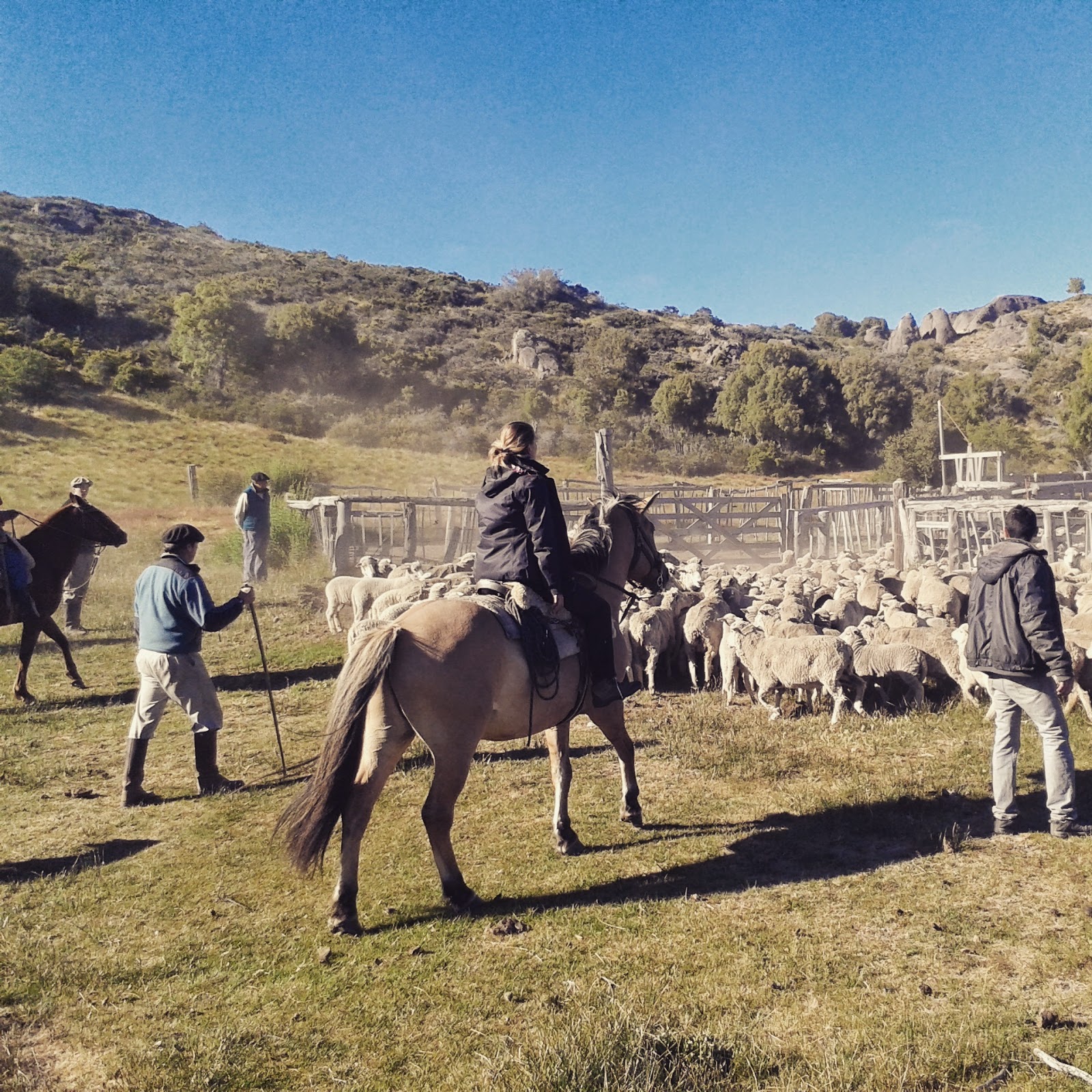
Herding the sheep started out as a fun job. It seemed easier than rounding up horses. The woolly 'baa-ing' huddle bumbled across the pastures, while we walked calmly behind on horseback, encouraging them along with 'ayyyyy-ups' and calls of 'siga siga siga'. If one panicked or strayed from the group, a quick step in its direction usually sent it bouncing towards the flock, and if not, the dog would dart round behind sending it back the way it came in a rapid scramble.

The bridge over the river caused the first bottleneck. The sheep at the front ground to a halt, seemingly blind to the chorus of shouts behind, and those behind started to shift and swivel; a mutiny was brewing. Then, all of a sudden, instead of looking at a sea of white, woolly bottoms, I was confronted with 250 baa-ing faces. In one movement, the flock flowed through the gaps between our horses and flooded towards the pasture.

The subsequent successful crossing seemed to rely on momentum: keeping them moving but not rushing them into a panic, a technique that was key for the next jam, which formed at the gates of the coral. However stupid sheep are, I couldn't help but feel that the flock leaders were dithering with a sort of knowing reluctance, and what followed confirmed that their reticence had reason...
I knew the herd was being marked and separated for sale, but I wasn't exactly sure what that involved. The reality was brutal. Each sheep was lifted on to the fence, back legs pinned behind their ears and bottoms exposed; a knife cleanly sliced through the flesh of their tail, and a hole punch marked the ear (essential work to prevent disease apparently). The girls were then dropped in a scrambling heap on the floor, running away with a bloody stump dripping down their back legs. The boys however were kept bottom-up, as a gaucho put teeth to testicles and castrated them in one gruesome mouthful. A grizzly spectacle. By the end of the morning, a small pile of bloody balls had been spat out onto the fence post, just above a sad mound of limp tails.
As it turns out, those were the lucky ones. That afternoon, I was unwittingly roped in to help bundle the remaining sheep into a lorry and off to the slaughter house. Under orders, I clambered into the back of the truck, was given a sheep and told to grip its leg tightly while the men tried to press the rest of the flock in after me. More scared of the gruff gaucho than I was of the startled sheep, I did my best to cling on to it, but my heart soon gave way to its struggles; I let it slip free when the team looked away. My morale sank even lower when I was then given another, this time instructed to hang onto it by the neck. Desperate to let go of the poor writhing creature, as soon as another sheep was thrown into the truck, I released it and leapt over the side of the lorry.

The silver lining of the afternoon was that, just before the truck gate was closed, two little lambs somehow managed to bounce their way to freedom. Happily, attempts to round them up failed; I watched with a smile as they high-tailed it to happiness in the pasture - for another year at least!


Thursday, 18 December 2014

The Pack Trip...

It was planned with military precision, according to a lengthy list that looked older than I was: four columns of typewritten script spread across a fragile sheet of scrumpled, brown A4. It turns out a huge amount of paraphernalia is required for a three-day trip on horseback; preparing 'los pilcheros' (the pack horses) every day was quite a feat. Their saddles alone - multiple pads, two wooden crosses, two girths and a confusion of leather straps - weighed a ton. They were then loaded with cumbersome suitcase-shaped paniers, an assortment of bags and a heavy tarpaulin, all strapped tight with a complex knot system that continues to baffle me. It was a palava repeated at least twice daily.

For our first stop, we unsaddled the pack horses as usual, but relatively little of their load was actually used. The venue, a small copse by a narrow stream, is one we frequent on day trips, and so the 'kitchen' is always left well-stocked: wooden chopping boards piled up in the crook of a tree, bottles of oil and vinegar balanced on the thick branches and mugs hanging from the thin ones. In the evening however, the paniers were emptied and everything was in use. That afternoon, we had ascended to the spectacular scenery and brisk temperatures of higher ground, making camp in the shelter of the forest. Tents, mattresses and sleeping bags were dished out to the riders, tea and cake served, and blackened pots and pans prepared for that night's dinner.
To economise on space, Carol (pack-trip expert) and I fashioned beds out of saddles - the pack tarpaulin as a base, saddle pads for mattresses, numnahs for padding and saddles for pillows. As such, anticipating a cold night out in the open, I savoured the warmth of the fire for as long as possible. I only shuffled away from the flames once - a brief but worthwhile venture to survey the stars from the meadow: the Southern Cross rather than the North Star, an upside-down Orion's Belt and a glittery dusting of unknowns. Otherwise, I huddled close to the coals, first simmering an enormous pot of rice, and then lingering over the embers with 'la bota' (the wineskin). By the time I snuggled into my sleeping bag, I was wearing seven layers, two pairs of trousers, three pairs of socks, a hat, gloves and a scarf. It was cosy!

When I woke up the following morning, the sun was still low in the sky, a light dusting of frost on the ground, and a can of water was bubbling in the fire (tended by Luca, a Mendozan leather artist also working on the trip). We woke up slowly over cups of sugary tea, rounds of mate and crusts of bread, before starting to pack up. However, just before saddling up, one of the riders announced they had discovered a dead fox in the meadow. To my surprise, Luca's eyes lit up: "En serio...? I'll take the skin!" he said excitedly, darting out of the forest.

A bewildered crowd gathered around him while he inspected the animal: a young male curled up in a ball with no sign of illness. Luca dangled it upside down by its tail looking at it critically, before declaring, "I'll slip the fur off like it's a jumper". Lowering the fox to the ground, he dropped to his knees and snipped a cut in the back foot. Then, to the squirms of onlookers, he started to blow the fox up as if it was a balloon. Mouth to fur, he puffed energetically into the fox's foot, pumping the air through the length of its body with his spare hand and lamenting not having a bicycle pump to hand. At this point, I retreated to the forest and busied myself with saddles, paniers and ropes...

I returned periodically to see the fate of the fox. The first time, Luca was elbow-deep, loosening fur from flesh; the second, it was strung up from a tree, fur half-way over shoulders (as Luca promised, much like a jumper). The third time I ventured over, I almost trod on its four paws, which lay in a pile not far off from where Luca was removing the eyes. I squeaked involuntarily and made an about turn back to the horses. Too gruesome for me!

The rest of the ride passed without major incident. Dropping down into lower ground, we traversed the hills in warm sunshine, barbecued joints of meat under the shade of the trees, and collapsed on the grass next to our horses for a siesta. By the end of the trip, I was engrained with an aromatic mix of dust, smoke and horsey grime, my H&M jeans had two sizeable holes in each buttock, and I felt like I could sleep for 24 hours straight... I can't wait for the next one!

Heading out on the 21 December, this time without the expertise of pack-trip maestro Carol, it will certainly be a very different Christmas.

Thursday, 4 December 2014

Naughty horses and hairbrained chases


I wasn't entirely sure what was in store when I saddled up with Paulo "a bajar los caballos" (to get the horses down). We had rounded up the seven kept within walking distance of the coral that morning and, instructed to choose one, I had picked Chameleon, a chunky golden dun with quirky white splodges. A brief text exchange the night before had decided that the farrier would come at 10am the next morning to shoe all 23 horses. It seemed like a lot for one weekend, particularly as 16 of them were scattered across an area that usually takes us half a day to loop on horseback. Yet I was soon riding alongside Paulo in the soft sunshine of early morning, heading across expansive grasslands towards the hills where they roam.

Paulo navigated by distinctive curves and trees in the surrounding foothills, leading us to a wire fence that was all but invisible unless a few metres away. We passed through the gate and joined a sandy track that skirted the edge of the mountain, upon which Paulo started scanning the landscape for horses. Squinting into the sunshine, he indicated with vague swings of his leather whip where they might be, scrutinising every blob of colour in the distance that wasn't green: the brown smudge of a cow, the white blur of a bleached rock, or the fleeting black streak of a deer. No sign however of a horse... But, relishing riding freely through the park with no particular time-scale, I rather hoped they would stay hidden.

We came across them when we had been going for about half an hour, grazing in a dip on the right-hand slope of the mountain. The monstrous white bulk of El Calafate, a thick-necked Pecheron-cross whose width almost doubles that of the other horses, gave them away. They seemed a friendly bunch: a muddle of chestnuts, golden duns, bays and blacks, some with a spine-length dorsal stripe or striking white patches, a couple of gangly-legged foals and a few angular veterans with shaggy coats. Seeing two of their number being ridden towards them, they raised their heads in curiosity; a few whickered, while others meandered over to snuff our boots and rub their heads on our horses' sides.

Once greetings were out of the way, Paulo turned a circle and started walking purposefully towards them, 'clucking' with his tongue and holding the wooden handle of his whip perpendicular to the ground, the leather thong dangling below: "Vamanos chicos". The herd obediently turned away from him and starting ambling off, taking their last snatches of grass as they did so. However, what began as a laid-back trundle rapidly gathered pace; soon the whole herd was flying along the skirt of the mountain in a disorganised rabble. They gathered momentum with the gradient of the slope, Paulo and I galloping along behind, until they reached the gate in the far corner, where they congregated obediently. I hovered behind them while Paulo dismounted to fiddle with the wire catch. As he did so, the herd shuffled around and snuffed at eachother impatiently. Then, as if they had been plotting it, all 16 did an about turn and scarpered, galloping straight past me into the grassy plains behind.

When Paulo looked up, they had all but vanished. For a moment, I stood stupidily where the herd had been, before being spurred into action by Paulo; he jumped on his horse, kicked it into a gallop and shouted at me to follow. With horses charging in every direction, I had no idea which I should try to round up first, and so just followed blindly. It was a hairbrained chase: leaping ditches, splashing through bogs and slaloming around bushes (occasionally crashing through them). I had soon forgotten all about the herd and was enjoyed the ride! Paulo, who had wisely chosen a fast and flighty black gelding, soon left me trailing behind. As he disappeared into the distance, I pulled up, Chameleon blowing heavily. Most of the horses seemed to have looped back towards the fence line, but two were lingering at the far edge of the pasture and a rebellious trio were making a beeline back towards the mountain, Paulo in hot pursuit. For a few painful moments, I dithered awkwardly, unsure whether to attempt to round up the lingerers, join in the chase, or just wait and leave Paulo to do the work. I opted for the latter, walking ahead to ensure the gate was open. It didn't take long for the splinter groups to be chased back, and all 16 swept past me a flurry heading towards the coral.

The final river crossing felt like the finish line, splashing through the belly deep water and spurring on the final few as we did so. We pulled up near the coral soggy and out-of-breath but smiling, the herd dutifully filing into the enclosure ahead of us. It had been a lengthy two-hour process to 'get the horses down', and it was well past 10am by the time we had un-saddled. However, my very British concerns that the farrier would be kept waiting were unnecessary, as we had cooked an asado and shared a round of mate before he actually turned up. Even so, in a day and a half, he worked through the entire herd back-to-back, trimming feet and fitting shoes while I clipped their manes with an enormous pair of aggressive looking scissors. An exhausting weekend!

Fortunately, "subiendo los caballos" (taking the horses up) the following Monday seemed a much more relaxed affair. Nobody was in a hurry to leave, and just getting the horses out of the coral proved a struggle: they congregated in a reticent huddle at the gate, lingered over the salt lick and mosied around rubbing their tails on the wooden posts. In the end, Paulo had to ride into the coral and chase them out with his horse. They soon fell into a strung-out group, marching towards the mountain; some cantered slowly, some walked, some stopped to roll in the dusty clearings, and a droopy-lipped black gelding brought up the rear with an unhurried plod. Yet whether chasing after a rowdy rabble or calmly steering a cohesive group, moving the herd is a real highlight, naughty horses and hairbrained chases included.

Thursday, 20 November 2014

Emergency food supplies, a treacherous journey and a looming test of survival skills

I sat in the back next to the barrel-bellied puppy we had plucked from the municipal pound that morning. With floppy legs, a droopy tail, downy tufts of black fur and a distinctly doggy pong, she was ungainly but endearing, and within five minutes, had wriggled onto my lap, where she stayed for the duration of the three-hour drive. We were heading to an isolated outpost high in the steppes of Parque Nahuel Huapi known as Las Mellizas (The Twins), so called because of the two lakes just behind it, one leading to the Pacific and the other to the Atlantic. José, the gaucho living there, had phoned to advise he was knee-deep in snow and running low on food over a week ago, but treacherous conditions meant reaching him was impossible. Now on his last ration of potatos, we couldn't delay any longer.

To make the trip, we recruited part-time photographer Paulo Sanchez and his smooth-cruising Land Rover Discovery called Matilda, which we stacked with food crates, bales of hay, rolls of wire (to reinforce the buildings), a chainsaw (for firewood) and the puppy (for company).

The journey began in the foothills of the park on a dirt track with small plots of fenced off land to one side - a few huts, a handful of animals and locals that waved in greeting as we passed, one round-faced with a thick neck and just two front teeth, another gruff and crinkled with scraggly grey hair. As we left them behind, the road soon deteriorated to a vaguely distinguishable trail and the wilderness of the steppes took over. Paulo pulled up to fasten a Go-Pro to the windscreen, put on a CD of Millennium Classics and opened a family-size bag of biscuits. We were soon engulfed in the expansive hillside: earthy multicolours of light lime greens, fading beiges and turquoise tints; curvy, colourful rock formations that swelled out of the hillsides and sharp, jagged edges that protruded from sandy dunes; long grasses peppered with dandelions and half-submerged swamps. Paulo expertly traversed terrain I would have thought impassable: crumbling tracks eroded to steep diagonals, sinking, water-laden marshes and crevasse-like dips. Only once did he pull up to assess the obstacle ahead - a particularly fast-flowing river, bulging at its banks with the snow melt. However, he only hesitated for a moment, before plunging onwards. Water sloshing up at the windows, we cruised through the currents.

Around lunchtime, we arrived at Las Mellizas, a grassy clearing with just four small huts (only one of which is in use) and a wooden coral. Set back from a wide, shallow stream and surrounded by hills, it blended easily into the steppes, except for the two horses that were galloping up and down the wire fence. As we trundled through the gate, José came out to meet us. I don't know if it was because I expected someone gruff, hardened and slightly wild, but José surprised me. Slim with dark skin and a mop of black hair protruding from under his boina, he was wearing boots, baggy jeans and a blue jacket - not much given the biting mountain air. He smiled warmly, revealing a diagonally chipped front tooth, and invited us in to the main hut.

Stark and simple, with splodges of cement squashed into any cracks in the brickwork, the hut had a distinctly makeshift feel. An enormous open fireplace stretched almost the length of one wall, a stack of firewood piled up to one side and the mantelpiece scattered with an assortment of necessities - a bar of soap, a candle, a battery and jump leads, a knife sharpening stone, a fishing line and float wrapped around a 7Up bottle... A sports bag hung from a horseshoe above the firewood, the only visible personal belonging other than the radio, which was balanced in a plastic crate nailed to the wall, and the jackets hanging next to it. The bed, narrow with two threadbare blankets, flanked one wall, opposite a dining table and a large rectangular window looking out across the steppes towards the stream. Three handmade, knee-height stools were arranged in the centre of the room around a black, wood-fire oven with two big metal teapots on top, the chimney passing through a rough-hewn hole in the roof.

We unloaded the car and introduced the puppy to his new stomping ground, before a round of yerba mate was prepared and an enormous slab of meat rolled into a pan, doused with salt and put in the oven. As a vegetarian who feels the cold and works in the arts, I could not have felt more of a city softie next to these hardened Patagonians. While I resembled the Michelin Man, barely able to walk for layers of clothes, they rolled up their sleeves and took off their hats. The food seemed to take an age to cook and, while the Patagonians sucked on mate, I had to keep sneaking to the car to raid the family pack of biscuits. Then, while I nibbled on a slightly soggy spinach empanada, they sliced meat off enormous juicy joints straight into their mouths, the ferociously sharp blade of their knife flicking dangerously close to their tongues. The puppy on the other hand, rapidly adapted to his new surroundings; showing no sign of feeling the cold, he gnawed happily on the discarded bones.

José had arrived at Las Mellizas few weeks ago, charged with taking care of the land and ensuring no-one enters. The snow had at one point reached his horse's girth and, that morning, he had eaten his last ration of boiled potatoes. Even so, he had learnt the lay of the surrounding land, restored the hut in which he was living, and made a start on the others. Now with fresh supplies, he is to stay until December, when he has four days off to visit his daughter on her birthday. Over dessert (fruit), it was proposed that, in his absence, 'la gringita' (myself) could take charge. To me, the suggestion seemed so farcical I assumed it was a joke. When I realised that it was a serious proposal, I had to swallow my shock and nod enthusiastically, hunching over my mandarin to hide my horror. While not one to shy away from an adventure, I seriously doubt my survival skills would stand up to four days in arctic isolation, let alone my ability to 'take care of the land' and 'guard against trespassers'.

I have since discovered that Carol, my host, once spent 10 days living at Las Mellizas with her 20-day-old daughter. As such, should the opportunity arise, I will have a crack (albeit armed with a four-day supply of spinach empanadas and red wine). Needless to say, I have been watching recent asados and how to make a good fire with studied interest!


Wednesday, 12 November 2014

The Club, the Vet and the Borracho

There are two polo pitches, 40 plus horses, four grooms and a pack of ferociously affectionate dogs at Retiro Polo, a polo club frequented by local Argentines and tourists looking for a taste of authenticity. Even so, a sleepy, relaxed sort of vibe pervades. Apart from match days, when there is a flurry of activity, each groom quietly goes about his own business with his horses, fitting work around the comings and goings of tractor drivers, vets, delivery men, friends and family. In the six weeks I worked there, it fluctuated between bracing temperatures with torrential rain, and serious sunshine at 30° plus. Some afternoons I huddled over a glass of tea warming up with home-fried donuts, others I rode to the village for an ice-cream. And as time went by, I settled into my own vague routine - grooming the herd, riding my favourites, mucking out, rolling bandages and cleaning bridles - and got used to the ebb and flow of visitors.

Horatio, a local vet and farrier, was a regular. With a mop of grey hair, bushy, expressive eyebrows and a kind, friendly face, he has a scruffy sort of charm about him. He often arrived in time for lunch, armed with bottles of 7Up, fresh bread and biscuits. Once, he turned up three weeks running and each time presented a different girlfriend; "A boat in every port", he explained the week after. He took a no-nonsense approach to veterinary treatment: I watched him 'open-up' a small puncture wound to release the pus by repeatedly jabbing the cut with scissors, and heard in detail how he sows up mare's private parts to prevent damage to their ovaries when pulling up sharply on the polo pitch. Eeesh.

Another familiar face was Roberto el Borracho (Roberto the drunk). Weathered and wrinkled, his shabby, oversized clothes barely hide his skininess, but he thwarts all attempts at help by declaring: "Prefiero ser el borracho conocido que un alcolico anonimo!" (I'd rather be a well-known drunk than an anonymous alcoholic). Affable and friendly, albeit with a slightly dazed, dopey air, he greets everyone with a wave and a toothy grin; for me, it's always a few words of surprisingly comprehensible English. He lives, on the goodwill of the club owner, by the abandoned house adjacent to the Polo Club. Ironically, the crumbling building houses a farmyard of animals, while he lives in a makeshift hut outside. He scrapes a living by charging locals to graze their animals on the neighbouring field that, ironically, doesn't even belong to him. I am told he used to groom for polo games, recruiting a troop of boys from the local village and delegating duties. Now, polo days behind him, he appears at least twice weekly. Hunched somewhat precariously on top of his horse, a black mare that wears a shabby, brown jute rug whatever the weather, he always comes bearing a plastic bag of eggs to give to the club owner.

Having got to know the locals and the horses, I was sad to move on from Retiro Polo (despite my ineptitude on the pitch). Now in Bariloche, Argentina's chocolate capital nestled in the foothills of the Andes, I've swapped sun cream for thermals. Instead of working polo ponies and grooming for matches, I will be leading mountain rides with tourists in the mountains. Let's hope my navigation skills prove better than my hand-eye coordination on the polo pitch! I should have bought a GPS...

Saturday, 1 November 2014

The Gauchos

Fortin San Pedro: a small jineteada (buck 'n' bronco) with a big prize pot. The raffle alone warrants visiting, with prizes including a herd of 10 horses and a collection of young cows. It draws gauchos from across the province, bringing extended family and multiple herds, such that the number of horses more than triples that of spectators. The fair itself however, is quite understated. The arena is about half the size of a football pitch and surrounded by tiered benches. Handfuls of spectators cluster at the top under the shade, while early-birds have cordoned off ring-side seats in front and rigged up canvas coverings, equipped with picnic tables, deck chairs, a cool box and even a stove. Outside the arena, a selection of stands sell everything gaucho - an array of metals bits, leather halters, intricately designed bridles, fearsome whips and long-bladed knives - and an enormous grill, tended by a rosy-faced, barrel-bellied gaucho, sells meat by the kilo and 7Up by the litre.

The morning is devoted to the jineteada. A wild horse is blindfolded and tied chin-tight to a stake in the ground, a pommel cautiously fastened around its belly. A gaucho mounts, settling himself as securely as possible, and the horse is released. A frenzy of leaping, plunging and grunting ensues, the gaucho clinging on top and thwacking it with a whip to make it leap all the more. After eight seconds, a bell is rung and two teammates ride to the rescue, squashing the bronco between their horses and lifting its rider to safety. Sometimes the gaucho goes flying in the first second, other times, the horse crashes to the floor mid-jump, scrambles to its feet to leap again and the rider inexplicably remains in tact and on top. But, whether they are flung to the floor or crushed under the horse, the gauchos just get up, dust themselves off and walk away looking tough. Hard as nails.

Lunch follows the jineteada, the 'hour-long' break stretching to three to accommodate the 1kg portions of meat, a lengthy siesta and a round of yerba mate (the Argentine equivalent for tea). Action resumes at 5pm: the Enlazada (lassoing). Four gauchos stand primed at one end of the arena. Wearing heavy duty gloves, legs spread wide in a solid stance, hips rocking rhythmically in time to the rope, they work the lasso in broad circles with full arm movements above their head. Meanwhile, just outside the arena, a foal is corralled into a narrow corridor fashioned out of plastic sheets, which are smacked energetically by gauchos on the outside. The foal, frightened by the rustling walls surrounding it, and the crack of the whip from the gaucho behind, launches into the arena at a panicked gallop. The gauchos have approximately 30 metres to try and lasso it, and the foal needs to fall flat for it to class as a successful lasso - the more times the better in terms of points.

The first, a striking black foal with white socks, flew into the arena. Before it had gone 20 metres, it nosedived horribly into a violent somersault when a gaucho lassoed its front legs mid-gallop. Thankfully, it scrambled to its feet and retreated to nibble at the grass at the far end of the arena. A succession of over 40 foals went on to run the gauntlet past the gauchos: some somersaulted, some skidded, some hopped helplessly with their legs bound together before being pulled down. Very few escaped, and only one managed to tug itself free of the rope, dragging the gaucho some 50 metres before he suceeded. I tried to convince myself that all survived unharmed to happily join the growing herd at the other end of the arena, but sadly, many ended up with bloody rope burns on their knees and pronounced limps. Then, just before closing, one was lassoed around the neck and yanked awkwardly to the floor. There, it lay lifeless except for the spasms in its hind legs. Unceremoniously tied to the back of a truck, it was towed away and the enlazada continued without pause. Barbaric.

However, brutality aside, elements of the gaucho lifestyle are captivating, and seeing them altogether was a bit like stepping back in time to a mediaeval fair. All wear traditional clothes much like they wore in the 1800s, attire that is as practical now as it was 200 years ago: slip-on canvas shoes (alpargatas) or soft, leather boots; lightweight, baggy trouser (bombachos) gathered at the ankle and often tucked into socks; a brightly coloured, patterned cloth tied at the waist, a long-bladed knife tucked in at the back (for asados) and often a beaded keyring (for counting cattle) to one side; most wear a loose shirt, some with a waistcoat or a necktie, and nearly all wear the trademark 'boina' flatcap.

The closing parade was quite spectacular. It involved hundreds of gauchos (and their extended families) in all their finery: skinny ten-year-old boys, proud and confident astride their mounts; pot-bellied moustachioed men; tiny girls holding tightly to the boy in front, wearing brightly coloured floor-length dresses spread across the back of the horse; beautiful women with long curly hair flowing from under their boina; and toddlers barely able to sit up straight, flopping forwards onto their horse's shoulders. The horses were just as diverse. Some were chunky and muscular with their tails chopped short just below the dock, others flighty and wispy; browns, blacks, greys, palominos and a huge variety of patchy specimens, known somewhat disparagingly as 'manchados' ('stained'). The herd up for grabs in the raffle - young, stocky ponies streaked with black and white speckles - was also in the parade. They swirled around their 'mother mare', ridden by a portly gaucho, with a kind of desperate urgency, anxious to stay as close as possible. Another loose herd, a collection of miniature ponies, trotted in quick step behind a boy of no more than eight.

Wave upon wave of horses entered the arena, until it was almost at capacity. Then, as soon as the last rider entered, they all filed out again. Those not camping over the weekend set to the roads to ride home in the twilight. Driving back, we followed the long procession for the best part of three miles. Traffic pushed to the curbside and slowed to a walking pace, the gauchos travelled three or four abreast, some horses loose, some ridden, local villagers cheering and waving as they passed. Quite the spectacle!


Friday, 24 October 2014

Polo lesson #1: "You have to look at the ball"

Four reins in my left hand, polo stick in my right (bouncing uncomfortably in the crook of my neck), I cantered the length of the pitch. I had been tasked with tapping the ball from one end to the other, but the horse ended up kicking the ball more times than I hit it. It was about 50:50 whether I made contact with the ball, and 50:50 again as to whether it moved more than a metre. After five minutes, the neat circular swing I practiced at the start had become dangerously wobbly and lasso-like. As a result, my horse started dodging left when I tried to hit the ball - an unhelpful but understandable instinct for self-preservation.

I was followed by my instructor, the Doctor, a former surgeon and polo fanatic who founded the polo club the year I was born. An exemplar of polo prowess, he scooped up the ball from wherever it ended up after my botched shots, showing off a wide array of sharp 360° swings that sliced the ball from under the horse's neck, or cut it from beside the hind legs. He shouted encouragement and instructions after each of my wild swipes: 'You have to look at the ball!', 'Hit the ball don't just touch it!', and after every shot he made, the ball appeared just ahead of me. While very convenient placement, it was unnerving when a hard ball rocketed past at body level. After one hit my horse squarely on the behind, I began to flinch every time I heard the clunk of his stick.

We did one run of the pitch at full speed, during which I completely lost control of both stick and horse. Unable to turn or stop, I didn't even make a convincing run to the goal, but went straight past it on the far right. Just a small taster of the terrifying pace of polo. I was also given an introduction on how to fight for the ball by 'riding off' the opposing player. The Doctor demonstrated by barging his horse up against mine and hooking his knee in front of my saddle. My horse, something of a polo veteran, sportingly shouldered up against the opposition for a while, but I was all too keen to retreat and give way!

After lesson #1, I was invited to join in a baby chukka of two against one on the polo pitch. Unable to hit the ball, let alone receive or aim a pass, I just galloped in circles and tried to look busy. I vaguely followed the instructions barked by my teammate, but in general, did my best to avoid going anywhere near the ball. Unfortunately, my horse was much more competitive; on more than one occasion, she skid into a sharp 180° turn and sped after the ball, despite the reluctance of her passenger. The experience took me back to my school days and haplessly running around the lacrosse pitch. At least this time there was a horse underneath me!

The lessons have offered a glimpse into what a real game of polo would be like: fast and ferocious, demanding extraordinary control of stick, ball and horse... Needless to say, it's not the sort of sport I will excel in!

Saturday, 11 October 2014

The Polo Game

"They're coming to play at 5pm". A phone call announces the forthcoming game. It may only be amateur polo - just 28 minutes of play spread over four chukkas, rather than 49 minutes and seven chukkas - but it is an intense, pressurised hour or more for the grooms. Each is responsible for two riders and eight horses, supplying fresh mounts for each chukka in exchange for two that have just played. The horses arrive from the pitch glistening with foamy sweat, their sides heaving and nostrils flared: seven minutes to untack them, swap their saddles onto fresh horses and take off their bandages before the next two arrive... The game is a chaotic blur of sweaty animals and dirty leather tack.

The preparation begins about 2 hours before. 32 horses are groomed; 64 legs are bandaged; bridles, saddles and bandages are piled up ready for use. A grid with the details of the game is passed around the grooms - which riders play which horses in what order - and there is a reshuffle of horses and equipment, before as many as possible are tacked up and their tails tied in a plaited knot. Then, the players turn up; the game gets underway. An exhausting hour or two later, they disappear as suddenly as they arrived.

A polo virgin and less than 48 hours in Argentina, my first game is a baptism of fire. I don't know my horses names, have never tacked up a polo pony before, and know the players only by the initials embossed on their tack. I am apprehensive, to say the least, about my complete polo ignorance. However, when the riders arrive, they are happy to give me a whistle-stop introduction. It turns out that the horses I had that morning christened as Sammy, Alfred, Molly and Pimms, are officially called Dalinda, Jacinta, Quarta Milla and Marie, and each wears a different, but equally aggressive-looking bit. I hastily scribble down names, distinguishing feature, type of bridle and order of play on a scrumpled scrap of paper. 

I'm also given a crash course on how to saddle a polo pony: instead of a buckle, a long leather strap is threaded through loops on the girth and the saddle, cinched suffocatingly tight and then knotted. Whether I lack technique or brute strength, it seems highly impractical and time-consuming when you have eight ponies to saddle at speed! A rapid demo on how to plait the tail into a neat bun follows, a fiddly piece of handiwork I am yet to master without tying multiple messy knots. The game itself is a whirlwind. I frequently fumble for the scribbled notes, trying to identify horse, bridle and relevant chukka, all the while being handed horses drenched in sweat and gasping for breath. The pace is overwhelming. 

Three weeks on and I still find games a bit traumatic. I have however picked up a few tricks of the trade: rub Vaseline on the girth so it's easier to cinch up; if the tail knot is unachievable, there is no shame in just using tape; if possible, have every horse saddled before the game even starts! I have also learnt the names of the horses, the bits and the players. I still need the scrap of paper though!

Saturday, 4 October 2014

An Argentine Groom #2

Hector is slightly detached from the other grooms. He sticks to his own horses, his own stable block, his own corale and his own routine. He's up at 5am to turn the horses out and reappears periodically throughout the day, whether to do his laundry, shoe a horse, or ride one. Slightly bow-legged, he prowls around the yard wearing pumps, loose chinos wrapped close to his calves by horse bandages, and a large cotton shirt that billows out behind him when he rides (when not covered by a woollen, M&S-style jersey). The carved wooden handle of a knife pokes out of his belt, and he often has a few loops of baling twine around his neck.

A polo player as well as a groom, entrusted with training the youngest horses and working the most difficult ones, there's no doubt that he is the most experienced horseman of the grooms. He couldn't look more at home on a horse. Legs thrust forwards and right arm held easily at waist height, he can put any horse through its paces, whether galloping across the fields and pulling up to a sharp stop, or practising razor sharp turns in the menage.

He's travelled across Europe with polo ponies, and has worked here for 17 years - he's currently sleeping in the guest room of the Polo Club House while waiting for the construction of his own on-site house to finish. Hardened perhaps by years of earning his living from horses, he's certainly on the severe side - he's been known to castrate a stallion with a kitchen knife to save on the vets bills.

He works with his son, a sweet but shy teenager who I've never heard utter a word. An efficient, self-contained duo, they go about their work wordlessly. Yet even so, Hector is a noisy presence on the yard. He hollers directions at his herd, 'aaaayy's' loudly at a horse if it misbehaves, sings as he works and, when he does stop to chat, speaks loudly in an incomprehensible garble.

It takes him two weeks to talk to me, during which time I'm referred to as 'la Chica'. We have since advanced to a 'buen dia Lottie' greeting, and a 'finitio?' bark if I'm near him when I get off a horse. Yesterday, he even gave me a few tips (and a thumbs up) in the menage when we happened to be riding there together. It may be slow, but it's progress!

Sunday, 28 September 2014

An Argentine Groom #1


When I first meet Paulo, he's brusque and almost surly.  Round-faced with smooth, dark features, he's wearing a baggy adidas jumper, nike trainers and a black flat cap; he could be a teenager, but for the rotund bulge of his belly and calm, confident manner. First off, he takes me to meet my horses: 'Son tuyos' he emphasises, as if pleased to pass on the responsibility. Trailing a handful of halters, we pass through a gate hidden under the trees and enter a large sloping square of land covered in patches of waist-high scrub - a field that is seemingly devoid of horses. With a gruff grunt and wave of his arm, he indicates that I walk in the opposite direction to him, and then let's out a deep 'hee-ahhh' holler that resonates from the depths of his belly. Six heads, ears-pricked, pop up above the bushes. Dotted randomly across the field, there are blacks, browns and one with a striking white blaze down its nose.

He hollers again and, to my surprise, the horses amble into a trot and form a small herd that trundles through the gap between us and towards the gate. Guided by whistles and 'hee-ahhh's', they lope into a canter and disappear single-file through the gate. By the time we catch up, they have bundled into a small square corale just beyond the stable block. A suspicious, tail-swishing huddle, they are young and skinny with coats shabby from the winter. As Paulo approaches, they shift their quarters and raise their chins warily. Unperturbed, he tiptoes towards them, traversing the mud with unexpected grace. He reaches one and, as it moves to shy away, gently slips an arm around its neck as if embracing it, fastening the halter as he does so.

Over the next few days, Paulo diligently instructs me in grooming, bandaging, tack cleaning and coraling, meticulously correcting the slightest variation in his instructions until my technique exactly mirrors his own. I begin to realise that his brusqueness is more economy of words than surliness, something that extends to his sense of humour - an abrupt comment or sarcastic remark is immediately softened by a toothy grin and a chuckle. It could also in part be shyness - when talking to other grooms, his words slur into one long garble, rushing out through smiling lips that barely part.

Paulo is one of ten brothers and father of two. He previously worked as a mechanic and, now 22, has worked at the 'caballeriza' (yard) for a year and a half. Ironically for a groom, he can't ride following an operation to remove a hernia. Instead, he exercises the horses up to six at a time in the corale, cracking a whip at their heels as they whorl around him. He fills the time he would be riding a variety of ways. Most often, it is food preparation and digestion. Elaborate lunches so far have included roast chicken, battered aubergine and chicken stews, on rainy days followed by  fried dough eaten with spoonfuls of dulce de leche. Digestion involves extended snoozing on the sofa: cap over face and hands on belly, the room fills with his snores.